Choosing a Leak Detection System for a Liquid-Cooled Data Center: The Questions to Ask First

Liquid cooling is now standard in high-density builds. That makes coolant leaks a design problem rather than an operational surprise, and it puts the choice of detection system on the critical path. A leak detection system chosen without asking the right questions upfront tends to under-perform exactly when it matters.
Here is a practical checklist for facility managers and design engineers evaluating options. And if you don't have time to work through it yourself, skip to the end: that's where the shortcut is.
Start with the liquid, not the sensor
Not all leak detection cables respond to all liquids the same way. Water and glycol mixes are conductive and call for a different sensing principle than a dielectric fluid used in immersion tanks, which conducts no current at all.
Questions to answer before specifying a cable type:
- Is the coolant conductive (water, water-glycol) or non-conductive (dielectric fluid, oil)?
- Are multiple liquid types present on the same site, for example a traditional water loop alongside an immersion cooling deployment? This may call for more than one sensing technology running in parallel.
- What is the liquid's viscosity and expected flow rate, which affects how quickly a leak reaches the sense cable?
|
Coolant |
Detection |
|
Conductive: water, water-glycol |
FG-DLC point sensor, FG-EC range sense cable |
|
Non-conductive: dielectric fluid, oil |
FG-OD range sense cable, FG-ODP point sensor |
|
Both on the same site |
Both cable types, one FG-NET panel |
Map where the liquid will actually go
A leak rarely stays where it starts. Detection cable placement should follow gravity and the room's actual geometry, not a generic layout.
- Is the floor a raised access floor or a solid slab, and which direction does it slope?
- Where are the low points where liquid will naturally pool?
- Where are the highest-risk connection points: CDUs, manifolds, quick disconnects, valves, pumps, rear-door heat exchangers, immersion tank seals?
- Which critical assets sit downstream of these risk points: IT racks, electrical panels, network cabling? These define priority zones for cable routing.
Define what "detection" needs to mean on this site
Not every site needs the same precision.
- Does the team need to pinpoint a leak's location along the cable, or is zone-level detection (which room, which row) sufficient?
- What sensitivity threshold matters: a few drops, or only a leak large enough to threaten equipment?
- How many detection zones or loops are required, and how many can a single monitoring panel manage? A panel that supports multiple sense cable types on shared infrastructure, such as TTK's FG-NET, simplifies scaling as zones are added.
Plan the integration, not just the sensor
A leak detection system that cannot talk to the rest of the facility's monitoring stack creates a blind spot rather than closing one.
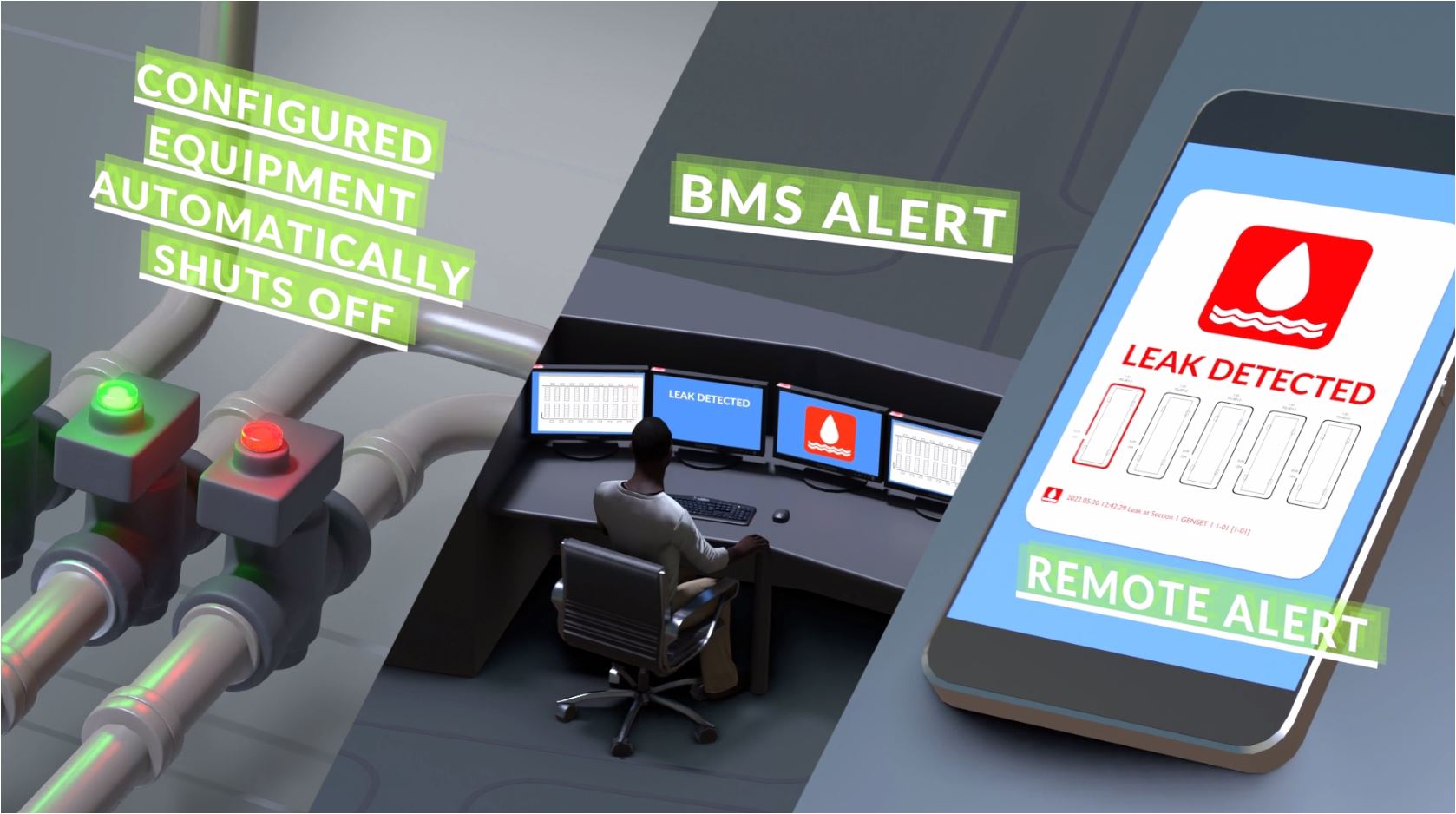
- Does the system need to report into the existing BMS or DCIM, and over which protocol (Modbus, SNMP, dry contacts)?
- Should detection trigger an automated response, such as closing a valve or shutting down a pump, or only raise an alarm for manual intervention?
- What is the expected time between detection and the response reaching the operations team?
Account for the environment and the system's lifecycle
- What temperature range does the sense cable need to tolerate, particularly near high-density racks?
- How resistant is the system to false triggers from ambient humidity or condensation, a common issue in cooled server rooms?
- Is the sense cable reusable after a leak event (cleanable and re-testable) or does it require replacement each time? This has a direct impact on cost of ownership over the system's life.
- Is this a new build or a retrofit into a live facility, and does installation require downtime?
- Will the site's liquid-cooled footprint grow? Can the system add zones without replacing existing infrastructure?
Close with the practical constraints
- Does the system meet the certifications required by the facility's insurer or by the client's specification?
- What local technical support and spare parts availability exist, particularly for sites in regions distant from the manufacturer?

A leak detection strategy built around these questions, rather than around a single product spec sheet, tends to hold up better as a facility's liquid cooling footprint evolves. The technology matters, but it only performs as well as the site-specific thinking behind where it is placed and what it is asked to detect.
TTK has been designing liquid leak detection systems since 1989 and holds a leading position in Europe, Middle East, and APAC, with a growing presence in the US. Our sense cable range covers both conductive and non-conductive liquids, paired with the FG-NET monitoring panel and management software. If you're working through these questions for a specific site, our technical sales engineers can review your layout and liquid types with you and help define the right detection strategy before you commit to a system.